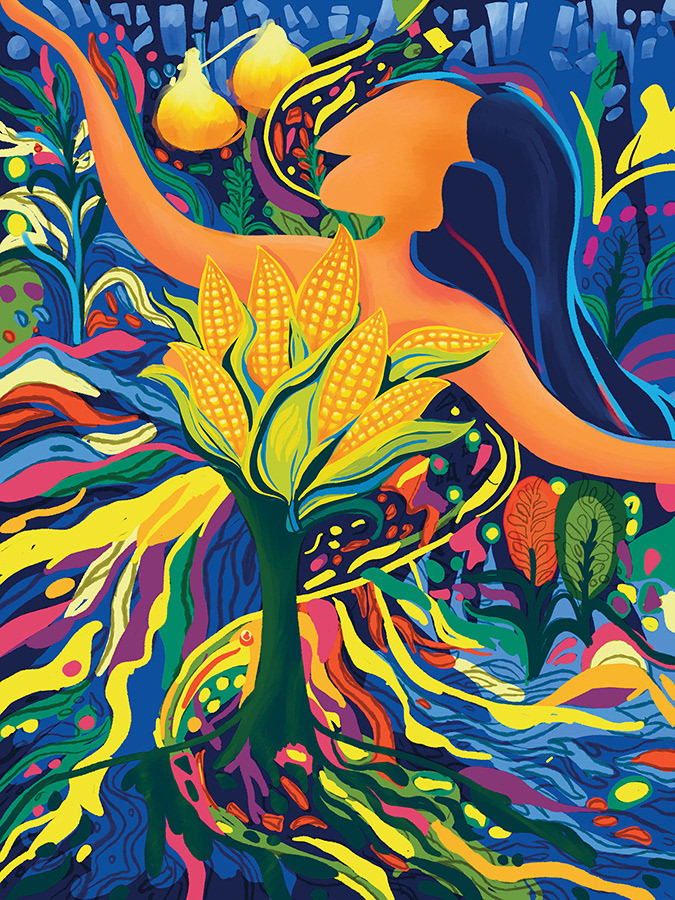
Dayra Sanchez, Anatomia del Maiz. Digital media. 18 x 24 inches. Florida International University,
USA, 2026
USA, 2026
Project Statement
This project explores the theme “Bodies of Color, Geographies of Form” through a focus on the Mexican female experience. The piece visualizes the body not as a fixed form, but as something shaped by land, culture, and lived realities. At the center of the composition, the female body merges with corn, a symbol deeply rooted in Mexican identity, sustenance, and ancestry.
This project explores the theme “Bodies of Color, Geographies of Form” through a focus on the Mexican female experience. The piece visualizes the body not as a fixed form, but as something shaped by land, culture, and lived realities. At the center of the composition, the female body merges with corn, a symbol deeply rooted in Mexican identity, sustenance, and ancestry.
The corn grows from within the body, suggesting that culture is not external, but something carried, inherited, and continuously cultivated. Surrounding the figure, flowing organic forms evoke landscapes, vegetation, and movement, reflecting the relationship between the body and environment. The work also subtly references the ongoing struggle for access to water in many communities, where women often play a central role.
The fluid shapes can be read as both life-giving water and the emotional and physical labor tied to survival. Through color, rhythm, and symbolism, this piece presents the female body as territory: a space where memory, resistance, and identity converge. It suggests that to understand the body, we must also understand the land it comes from.
Self reflection
Working collaboratively on this project allowed me to expand my perspective beyond my own cultural experience. Being part of a group with members from Asia and Africa encouraged me to think about how the female body is shaped differently across geographies, and how shared themes can emerge through distinct cultural lenses Throughout the process, we exchanged visual references, ideas, and feedback, which helped me refine my concept and approach. Seeing how others interpreted the relationship between body and place pushed me to be more intentional with my own symbolism, particularly in how I represented Mexican identity through elements like corn and organic forms.
Working collaboratively on this project allowed me to expand my perspective beyond my own cultural experience. Being part of a group with members from Asia and Africa encouraged me to think about how the female body is shaped differently across geographies, and how shared themes can emerge through distinct cultural lenses Throughout the process, we exchanged visual references, ideas, and feedback, which helped me refine my concept and approach. Seeing how others interpreted the relationship between body and place pushed me to be more intentional with my own symbolism, particularly in how I represented Mexican identity through elements like corn and organic forms.
One of the most valuable aspects of this collaboration was recognizing both the differences and connections between our perspectives. While each of us focused on our own cultural context, our ideas intersected around themes of identity, environment, and resilience. This experience reinforced the
importance of dialogue in creative work. It showed me that collaboration is not about merging ideas into one, but about allowing multiple voices to exist together, creating a richer and more layered understanding of the theme.
importance of dialogue in creative work. It showed me that collaboration is not about merging ideas into one, but about allowing multiple voices to exist together, creating a richer and more layered understanding of the theme.