Miguel Andrade. Transboundary, Mixed media. 18 x 24 inches. Florida International University,
USA, 2026
USA, 2026
Project Statement
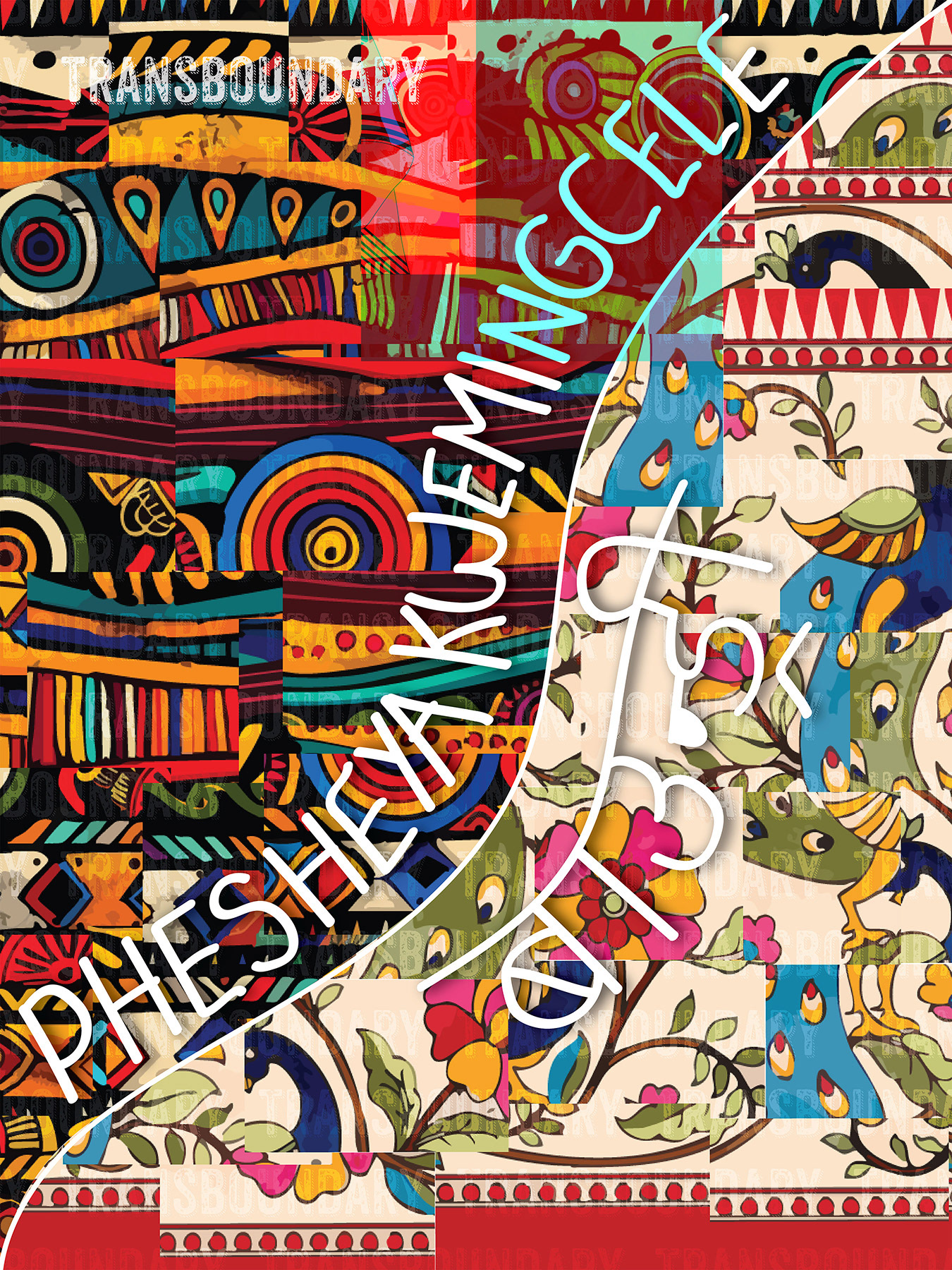
As a group, we chose the topic of Borderless Studios. My intention with this project is to bring together all of the cultures involved in this project using the different textile patterns in both the South African and Indian cultures. In the top left corner, I used a pattern used in South Africa, mostly on women’s head wraps. Both patterns used were cut into different pieces and then placed together with a purpose, rearranging piece by piece without losing their properties. On the bottom right corner, I used a famous ancient Indian textile printing art pattern called Kalamkari, which women use a lot on their dresses and clothing accessories. I connected with the word "Transboundary" to represent the idea of overcoming any boundary or limitation that could be between countries or art cultures. I incorporated the word "Transboundary" in different languages, such as Hindi and Zulu, which are the most common languages used in each country. I also added a drop shadow effect on both texts to highlight them from the background patterns. Last, I added a text pattern with the word “Transboundary” in English with a low opacity used as a background print on top of the other patterns. Only one “Transboundary” word out of the entire pattern is highlighted to bring its purpose and to bring together all three cultures, available for being understandable, no matter if you speak only one of the three languages or multiple.
As a group, we chose the topic of Borderless Studios. My intention with this project is to bring together all of the cultures involved in this project using the different textile patterns in both the South African and Indian cultures. In the top left corner, I used a pattern used in South Africa, mostly on women’s head wraps. Both patterns used were cut into different pieces and then placed together with a purpose, rearranging piece by piece without losing their properties. On the bottom right corner, I used a famous ancient Indian textile printing art pattern called Kalamkari, which women use a lot on their dresses and clothing accessories. I connected with the word "Transboundary" to represent the idea of overcoming any boundary or limitation that could be between countries or art cultures. I incorporated the word "Transboundary" in different languages, such as Hindi and Zulu, which are the most common languages used in each country. I also added a drop shadow effect on both texts to highlight them from the background patterns. Last, I added a text pattern with the word “Transboundary” in English with a low opacity used as a background print on top of the other patterns. Only one “Transboundary” word out of the entire pattern is highlighted to bring its purpose and to bring together all three cultures, available for being understandable, no matter if you speak only one of the three languages or multiple.
Self-Reflection
I really enjoyed collaborating with students from South Africa and India. The experience was both challenging and eye-opening. The time zone differences were the biggest obstacle; however, what made the challenge worthwhile was seeing how differently each of us approached the same design problem.
Color, composition, and cultural references were not interpreted in the same way by everyone, and that tension encouraged us to question our own instincts and communicate more intentionally. By the end of the project, the distance felt less like a barrier and more like an essential part of the experience. Ultimately, I found the collaborative process meaningful and rewarding.