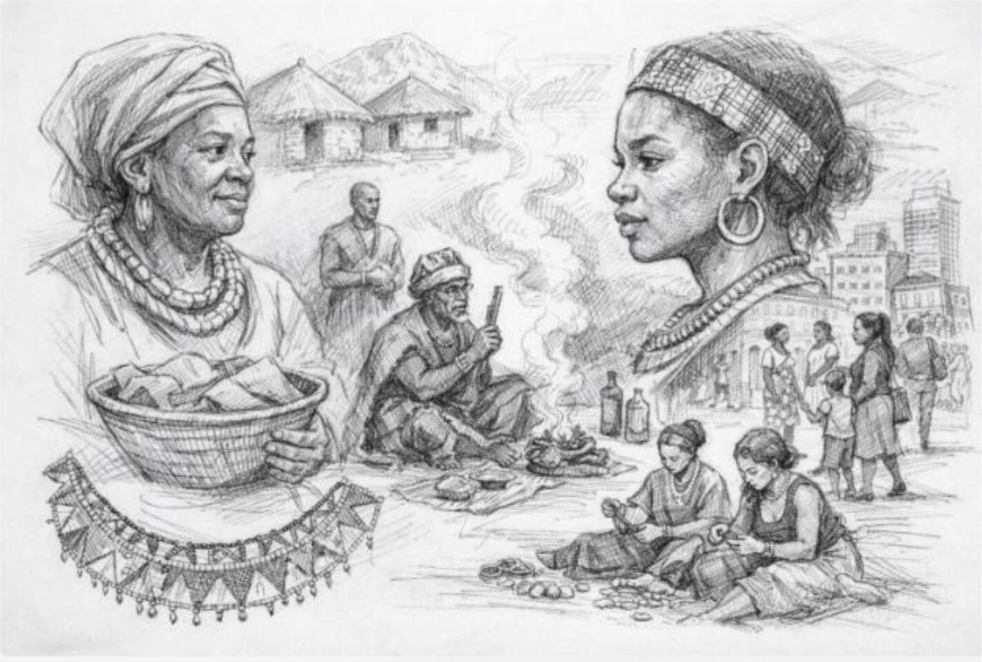
Ayabonga Gxula, rituals and memories, Digital drawing, Central University of Technology, Free State, South Africa, 2026.
Project Statement
This project explores the relationship between women, ritual, texture, and memory within cultural contexts in South Africa. The work is based on personal experience and reflects how culture exists across different communities such as Zulu, Xhosa, Sotho, and many more, both in traditional settings and in urban environments.
In many cultural practices, rituals involve communication with ancestors. From my understanding, this process often requires the voice of an elder man, who speaks on behalf of the family during ceremonies. This role is important and respected because it follows traditions that have been passed down through generations.
At the same time, women play a significant role in maintaining cultural life. Women contribute through preparing ceremonies, organising gatherings, and passing down cultural knowledge.
They are also involved in craft practices such as beadwork and traditional clothing, which carry important textures that represent identity and heritage.
The visual work reflects this balance by showing both men and women contributing to cultural practices. Men are represented in leadership roles within rituals, while women are shown preserving cultural memory through everyday practices, community participation, and cultural expression. The inclusion of both rural and urban environments highlights how culture continues to exist and evolve in modern life.
Overall, this project demonstrates that cultural identity is sustained through the combined roles of both men and women, each contributing in different but equally important ways.
Self Reflection
Through this collaborative project, I learned the importance of sharing cultural knowledge and perspectives within a group. Engaging with others helped me understand how different cultures interpret similar ideas such as ritual, memory, and identity.
I also learned how to balance different viewpoints while staying true to my own cultural understanding. This included recognising the role of men in leading certain rituals, while also highlighting the important contributions of women in preserving cultural practices and community life.
The process improved my ability to think critically and represent culture in a respectful and meaningful way. It also helped me develop stronger visual communication skills by translating research into a creative visual form.
Overall, this experience allowed me to grow both academically and creatively, and to produce work that reflects both personal experience and shared cultural understanding.